

Where Did the Idea for ASAP Come From?
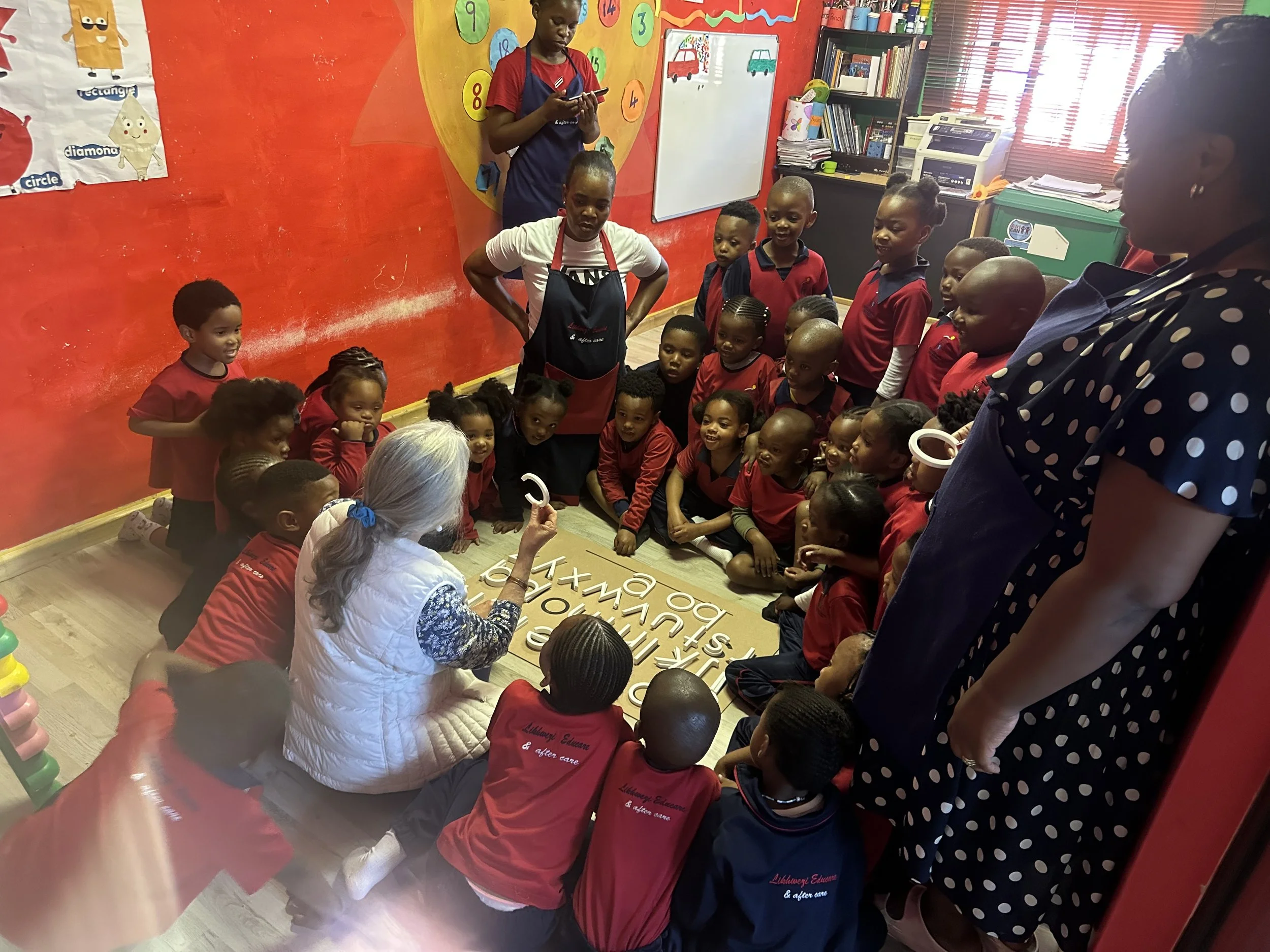
Nancy has returned several times to share resources with Nomonde Tshamlambo, the principal of the Likhwezi Educare, following her first four-minute visit in 2018. Enthusiasm was high when Nancy brought them the phonics early reading system called SOUNS in 2023. Unfortunately, the LIkhwezi School is a two-day drive south from Pretoria which precludes enrollment with ASAP and PEN. However, the school is close to Nancy's heart and remains an informal beneficiary.
Four Minutes in Langa
How a Battered Coffee Can Sparked a Preschool Revolution
June 2026 story by Erin Dunigan following interview with Nancy Schongalla
During a chance encounter at a Princeton Seminary Christmas party back in 2014 Nancy Schongalla happened to meet Professor Malan Nel and his wife Marlese from South Africa. Malan is a beloved and deeply respected professor at the University of Pretoria who has written 28 books on pastoral care, youth ministry, and church development.
Malan was interested in Nancy’s work at the seminary – focused on the psychological and spiritual formation of seminarians for ministry. “We need to get you to South Africa to talk about what you are doing at Princeton Seminary to support the mental and spiritual health of students and spouses.” Little did either of them know where that chance encounter, and invitation, would lead!
It was not until August 2018 that Malan managed to get Nancy to South Africa. For three weeks at three universities, Nancy spent a morning talking with seminarians, a morning with denominational representatives and professors, and a third morning with local clergy,
But it was during a final week in Cape Town, where Nancy took a tour of Langa Township that her understanding of "formation" was completely rewritten.
Nothing in Nancy’s academic background had prepared her for the reality of Langa. A vast, deeply under-resourced community built out of the painful legacy of apartheid, Langa is a landscape of miles of corrugated metal shacks squished together. Basic infrastructure—like grocery stores, community centers, and well-funded schools—is entirely absent. The sheer scale of the poverty was breathtaking, even paralyzing.
“On the township tour I saw poverty like I have never seen it before,” she said. “Women selling the heads of sheep they cooked over trash-fueled fires, jobless people everywhere, no electricity, no running water - I can’t even find words for it.”
And then, the tour stopped at Likhwezi Educare for four minutes.
This was an informal day care started by a local woman named Nomonde Tshamlabo. With no formal training, she rented a building, and immediately had tons of babies through 5 year-olds on her rolls. Nancy walked inside and stood there.
In one corner, children were tightly packed together, loudly singing the alphabet song. In another, a large group worked on numbers. In the kitchen, women were preparing food for nearly a hundred small mouths. On a little table sat a single, battered coffee can meant for tourists to drop spare bills into. The school’s survival depended on those random donations.
Right there, Nancy knew.
Watching Nomonde navigate that crowded space, Nancy knew that true development was happening right here, against impossible odds, driven by a woman who simply refused to let her neighborhood's children be forgotten or at risk on the streets.
“I knew in my heart - I am going to try to support this school beyond what I am putting in the tin can at this moment.”
The Four Minute Catalyst
When Nancy returned to the United States, that four-minute realization became a mission. She began mobilizing friends, colleagues, and churches to help fund educational toys and food.
When she saw Malan and Marlese again in Princeton that October they asked her what was the most meaningful part of her time in Cape Town. “I told them hands down, it was those four minutes at a preschool in Langa Township and if there is any way I can help, I want to do it.”
Marlese’s response was the catalyst she had been waiting for. “I used to own a store of educational toys in Pretoria and I know all the suppliers, every toy, what it does for what age, and if you want, I can help you help that school.”
So it began.
The Invisible Crisis of Play
As Nancy began to dig deeper alongside South African educators, she uncovered a staggering national crisis.
Studies show that 90% of brain development happens by the age of five - or it doesn’t happen. If it doesn’t happen, it is much harder for the brain to fill in those gaps later in life. “Despite raising my own son, I never fully recognized that toys are so much more than entertainment for a child; educational toys are essential because play is how children learn; access to toys and books sets children up for success in school and in life,” she said.
Yet, an alarming national study has revealed that 80% of South African fourth graders cannot understand what they read, and 40% cannot read at all. Without early intervention, these children face an almost certain trajectory of dropping out of school and permanent unemployment.
The missing link? Play.
Toys are not just fluff to entertain a child; they are the literal tools through which a preschooler’s brain maps cognitive, social, and motor skills. In under-resourced townships, children have no toys. They piece together scraps from trash heaps just to have a makeshift doll or ball. Women across these communities step up out of love to run informal “creches” (babysitting operations) in their homes to keep children safe, but they have zero budget for educational resources or training.
Again, Malan and Marlese helped pave the way for what was next, connecting Nancy with an NGO called PEN - Participate, Envision, Navigate. PEN had been working in the townships and told Marlese and Nancy - if you want to do something for preschoolers we have a mission for you!
PEN had been trying to resource the women running these informal creches - inviting them to come to Pretoria for training - but most did not have the time or the money to get there.
So, PEN invited Nancy and Marlese into the mission of bringing training to the women- by setting up libraries of educational toys in the rural townships and urban ghettos where these women live.
That is when ASAP - Adopt a South African Preschool - was born.
The ASAP Solution: Turning Daycares into Launchpads
Instead of trying to fund individual preschools one by one, ASAP together with PEN pioneered a brilliant, scalable, community-driven solution: Educational Toy Libraries.
ASAP and PEN partner to establish central toy libraries in areas where there are numerous informal daycares in a walkable radius. Each library is equipped with high-quality, durable educational toys, puzzles, and learning games for 30 preschools to borrow. A crucial dimension is that the libraries serve as training grounds.
Every week, local women running informal daycares walk to the local ASAP hub. There, preschool coaches funded by PEN train them on the theme-based national curriculum—covering everything from early mathematics and phonics to hygiene and teamwork. The women learn exactly how each toy stimulates a child's cognitive, physical, emotional, and relational development. They love borrowing toys to bring them back to their classrooms and having a daily lesson plan for the next week has been a gamechanger.
Today, ASAP supports 242 preschools, impacting nearly 12,000 children and empowering 1,200 women as teachers. Standardized testing is already proving the efficacy of the model: 89% of children in schools supported by ASAP and PEN have shown significant growth between February and October 2025 on the benchmark capacities required to succeed in elementary school.
The Full Circle
Decades ago, in 1978, as a young seminary student at Princeton, Nancy had intuitively founded a campus childcare center to support isolated parents and give single student volunteers an opportunity to be with young children. She hadn't connected that memory to South Africa when she first stood in Nomonde’s preschool. But looking back, she realizes her soul remembered what her brain had forgotten: that a child's future is entirely decided by how we care for them before age five.
ASAP operates entirely on private donations, with 100% of its direct funding coming from individuals and organizations who want to make a measurable, verified difference. It costs roughly $9,200 to fund the physical infrastructure, security doors and windows, shelving and toys for a new library hub which gradually can help 30 neighborhood daycares become thriving preschools. ASAP’s 9th toy library training hub will open in August 2026, in Soweto.
Not only are children being prepared for school success, but they are also gaining skills for life and eventual gainful employment. By turning informal daycares into preschool launchpads ASAP is helping South Africa overcome the plague of generational poverty.
An old African proverb says, “A child who does not play is like a bird that does not fly.” ASAP is changing the sky for thousands of children, one toy, one teacher, one coach, and one community at a time.